Monday, February 25, 2013


Air conditioner
How it works...


An air conditioner is able to cool a building because it removes heat from the indoor air and transfers it outdoors. A chemical refrigerant in the system absorbs the unwanted heat and pumps it through a system of piping to the outside coil. The fan, located in the outside unit, blows outside air over the hot coil, transferring heat from the refrigerant to the outdoor air.



Most air conditioning systems have five mechanical components:
A compressor
A condenser
An evaporator coil
Blower
A chemical refrigerant


Sunday, February 24, 2013


Central heating system in

Manchester

A controlled burn of fossil fuels, like gas, takes place within the boiler and the heat produced is transferred to water.

 A gas boiler consists of various components which transfer the heat energy from fuel to a heating system.

A heating system consists of:

 •A boiler (the heat source)

•A cylinder (to store the hot water)

•A pump (to push water around the system)

•A timer (to turn the hot water and heating system on automatically)

•Room thermostat (to control the temperature of the house)

•Cylinder thermostat (to control the hot water temperature)

•Radiators (to heat the room)                  


There are different types of boiler:

 •Heat only boilers - work in conjunction with a hot water storage cylinder and cold water top up tanks to provide both central heating and hot water

•System boilers - contain all the components (pump, expansion vessel etc.) that are normally external to a heat only boiler

Monday, February 4, 2013


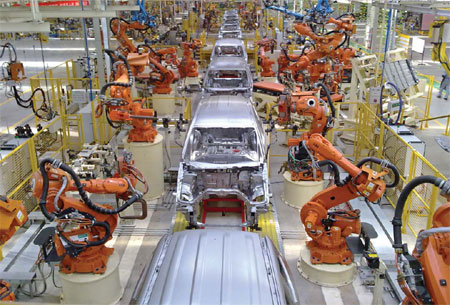
Robots in car manufacturing


Significance
·         Robots were initially retained to perform precise welding chores and other repetitive tasks that humans had long found boring, monotonous and injurious. By using robots to weld, handle dangerous objects and place items, auto manufacturers were able to ensure a consistent product with a minimum of worker injury. Currently, 50 percent of all robots in use today are used in automobile manufacture.
Function
·         To make a robot work, a computer program is installed on its controller computer. This provides a set of precise instructions--based on geometry and carefully timed--that tells the robot where to place things, how to rotate them, where to weld and how to perform all of its other functions. Robots do not think for themselves, and must rely on humans to provide instructions. Robots also can work in more extreme environments on their own, or they can work alongside humans, assisting them in their day-to-day jobs--such as moving or rotating a car so humans can work on parts of it that would normally be difficult to reach.
Benefits                                                               
·         Robots have been a boon to the auto-manufacturing industry. They have significantly reduced worker injuries, including repetitive stress injuries and more significant mishaps that can do major harm. Additionally, the robots turn out a more consistent product at a significantly cheaper cost than can humans. In the 1970s, American auto manufacturers were maligned for the poor quality and bad engineering of their vehicles.